
Market conditions have shifted. Unemployment is edging up and employers are managing costs and headcount carefully, while housing and living costs are still rising. That puts pressure on both sides: businesses need to keep their good people without adding cost, and those people are more likely to be financially stressed between paydays, which shows up at work as absenteeism, turnover and requests for pay advances. Earned Wage Access (EWA), which lets employees access part of the pay they have already earned before payday, addresses that directly, at no cost to the employer and without changing how you run payroll. Carbal Medical Services reduced absenteeism by 45% after introducing it.
This guide explains what EWA is, how it works, what it costs, how it differs from loans and pay advances, and what results employers are seeing. If you are an employee looking to access your pay early, see how Paytime works for employees.
What is Earned Wage Access?
Earned Wage Access (EWA) gives employees flexible access to wages they have already earned, before their scheduled payday. It is also known as on-demand pay, early wage access, flexible pay access or wage streaming.
An employee who has worked a week of shifts has earned that money. EWA simply lets them access a portion of it when they need it, typically up to 50%, rather than waiting for the pay cycle to end. The amount accessed is reconciled on payday: if they accessed $200, their next pay is $200 less. That’s it.
It is not a loan. No money is lent, no interest is charged, no credit check is performed and there is nothing to repay.
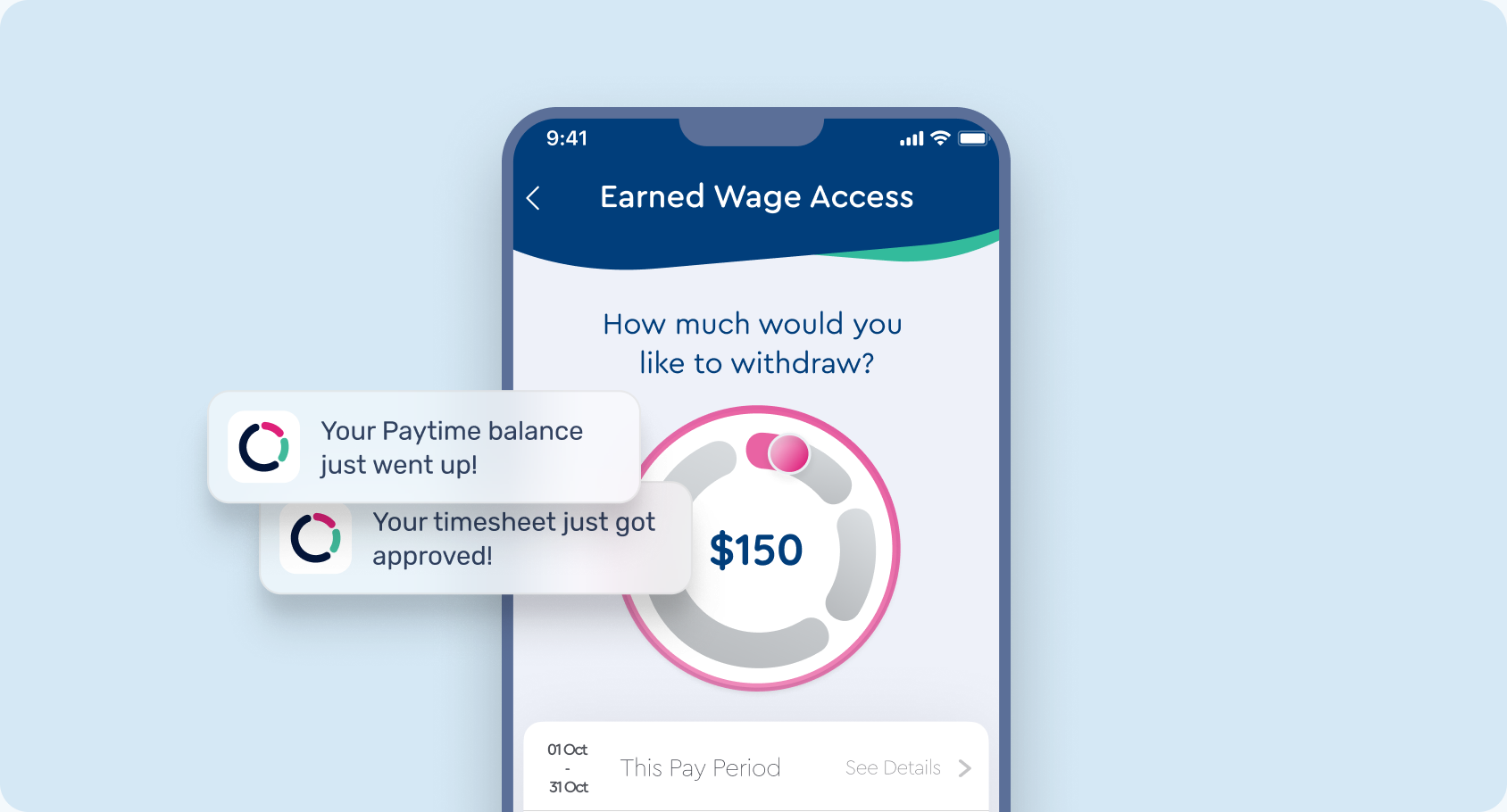
How Earned Wage Access works
- Payroll integration. Paytime connects to your existing payroll and time and attendance systems. Your pay cycle does not change and there are no ad hoc payments to process.
- Employees access earned pay. Employees see their accrued earned wages in the Paytime app and can access a portion of them in minutes.
- Payday reconciles automatically. Payroll runs as usual. Amounts accessed are automatically reconciled in the next pay run.
Employers set the guardrails: the percentage of earned wages that can be accessed, how often, and which employees are eligible. Implementation typically takes less than a week and adds no work for the payroll team.
Is Earned Wage Access a loan?
No. This is the most common question employers ask, and the distinction matters. A loan involves a lender, a credit assessment, interest and a repayment obligation. EWA involves none of these. Employees access money they have already earned, and the amount is simply deducted from their next pay.
Because no credit is being provided, employer-sponsored EWA is not a credit product. It is worth knowing that some consumer “wage advance” apps operate very differently: they lend against future pay, charge a percentage of the amount, take direct debit authority to collect repayment, and many are licensed and regulated as credit providers. Harvard Kennedy School research on EWA draws the same line: employer-sponsored programs recovered through payroll are structurally different from consumer apps that debit bank accounts, and the problems regulators worry about most, such as overdraft fees, “tips” and double-dipping across multiple apps, belong to the consumer-app model. The table below shows the difference.
| Earned Wage Access (Paytime) | Traditional pay advance | Payday loan / consumer wage advance app | |
|---|---|---|---|
| What is accessed | Wages already earned | Money the employer lends ahead of payday | A loan against future pay |
| Impact on employer cash flow | None | Employer funds the advance | None for the employer |
| Interest | None | Usually none, but admin heavy | Interest and/or fees, often a % of the amount |
| Credit check | No | No | Income verification or credit check |
| Repayment | Nothing to repay; next pay is reduced by the amount accessed | Deducted from future pay, manually | Direct debit on payday |
| Payroll impact | None, runs as usual | Extra payroll runs and deductions to manage | None for the employer, but staff financial stress rises |
For a deeper look at the differences, see Pay advances vs earned wage access: what Australian employers should know and How payday lenders disguise themselves as EWA providers.
What does Earned Wage Access cost?
For the employer, nothing. There is no change to payroll or cash flow and no working capital tied up: wages accessed are reconciled at the next pay run.
For the employee, a small flat transaction fee applies each time they access their pay, comparable to an ATM fee, regardless of the amount. Employers can choose to cover this fee as part of the benefit, in which case employees pay nothing at all. There are no interest charges, no percentage-based fees and no late fees, ever.
The employee financial stress crisis in Australia
Australia’s labour market has shifted. Employee expectations have evolved rapidly, particularly through the cost-of-living crisis, and financial pressure is now one of the biggest drivers of turnover and lost productivity.
- 38% of Australian workers plan to leave their employer within 12 months, and wellbeing is the second-biggest factor in choosing an employer, behind only pay (PwC Australia, What Workers Want, 2021).
- $23,860 is the average cost of hiring a new employee in Australia, more than double the figure a year earlier (ELMO Software survey, cited by the Australian HR Institute).
- 21% of employees say their productivity has declined because of financial stress, and financially stressed workers lose around 12 hours a week to reduced productivity (AMP Financial Wellness Report, 2022).
- 46% of Australians name financial pressure as a significant factor in their distress (Beyond Blue, Australia’s Mental Health and Wellbeing Check, 2024).
The modern employer has to look beyond salary and provide benefits that support day-to-day financial life. That is where EWA fits.
Why financial flexibility matters more than ever
Flexibility is no longer just about remote work or a four-day week. Workers across Australia are looking for employers who understand their day-to-day financial reality. A sudden car repair, a rent deadline or a medical bill should not force someone onto a payday loan or a credit card because payday is still ten days away.
Traditional pay cycles leave many workers financially exposed between paydays. For Australian employers, offering EWA through a trusted platform is a dual opportunity: support staff when they need it most, and position the business as an employer of choice in a competitive market.
The business case for Earned Wage Access
Done properly, EWA delivers measurable results across the metrics HR and finance leaders care about.
Talent attraction and retention
- 79% of workers are more willing to switch to an employer that already offers earned wage access (Visa, Earned Wage Access Preferences Survey, 2019).
- 89% of workers say they would work longer for a company that provides earned wage access (Visa, 2019).
- 12% lower probability of leaving. A Harvard Business School study of EWA users found they were about 12% less likely to leave their employer in the next pay cycle than non-users, controlling for demographics (reported in Harvard Kennedy School, 2023).
- More applicants. Job ads that mention EWA attract more candidates: Addex Group saw a 44% increase in applicants when Paytime was mentioned in the job description.
Productivity and shift coverage
- $66.8 billion a year is what financial stress costs the Australian economy through employee distraction and lost productivity (AMP Financial Wellness Report, 2022).
- 84% of workers spend time at work thinking about or dealing with their personal finances (Visa, 2019).
- Faster shift filling. Paytime clients report a 20% increase in shift filling, because staff can access the pay from an extra shift straight away.
Operational efficiency
EWA replaces the informal pay advance system many businesses run today. No more staff approaching managers for advances, no more early payroll runs, no more manual deductions. Paytime integrates with payroll, employers define their own policies for access caps and frequency, and the process takes seconds per pay run.
Case in point: Supabarn offers Paytime to its retail staff. Uptake reached 43% in the first month, shift filling became 32% faster, and within months the business had eliminated pay advance requests entirely.
What to look for in an Earned Wage Access provider
Not all EWA solutions are created equal. Five things to check before you choose a provider:
- Seamless payroll integration. The system should not disrupt payroll or require changes to your pay cycle. The best providers integrate with your systems and handle the complexity for you.
- Flexibility and employer control. You should be able to set your own rules: percentage caps, withdrawal frequency and eligibility criteria.
- Transparent, employee-friendly pricing. EWA should never behave like payday lending. Look for a flat, transparent transaction fee, not a percentage of the amount accessed, no “tips”, and no hidden charges. Harvard Kennedy School reaches the same conclusion, and recommends employers consider sponsoring the cost.
- Built-in financial wellbeing support. Leading platforms, including Paytime, pair wage access with budgeting tools, access to qualified financial counsellors and financial literacy content.
- Proven results. Ask for case studies. Providers like Paytime have verified results from clients such as Hornsby Inn, McGrath, Motorama and Rocky Sports Club showing lower turnover, better morale, faster shift filling and the end of pay advance requests.
Security and compliance belong on the checklist too. Paytime is ISO 27001 certified and SOC 2 compliant, and operates under the Australian Privacy Act.
Real-world results from Australian employers
A Sydney hotel using Paytime to hold onto hospitality staff in a market where venues compete hard for the same people. Retention improved, and staff began referring their friends.
“Since introducing Paytime, we’re holding onto our staff a lot longer, and they’re even getting their friends to bring in resumes.”
Differentiated themselves in a tight employment market, improved agent engagement and retention, and heard positive feedback from employees managing commission-based cash flow.
“Getting Paytime was a no brainer. Helping our staff with financial flexibility at zero cost was an easy decision.”
A 39% reduction in staff turnover, 80% adoption within weeks, 44% more job applicants when Paytime was mentioned in job ads, and the elimination of all pay advance requests.
A 45% reduction in staff absenteeism, 30% faster shift filling and a more loyal workforce with lower turnover.
46% uptake in the first month, 34% faster shift filling, stable uptake across all locations and measurable boosts in morale and shift coverage.
“Being able to offer our employees their money straight after a shift is a huge drawcard.”
How to launch an Earned Wage Access programme
- Assess your workforce needs. Identify the staff segments most likely to benefit: casuals, shift workers, commission-based earners, and even higher earners who want to put pay into a mortgage offset account sooner.
- Choose a scalable EWA partner. Select a provider with proven payroll integration, strong data security, compliance with Australian privacy law and a track record of customer success.
- Customise your policy settings. Work with your provider to define withdrawal caps, eligibility rules and guardrails.
- Promote internally and provide education. Adoption is key. Communicate through email, SMS, posters and manager meetings, run FAQ sessions, and highlight the financial wellbeing content to drive uptake.
- Measure impact and iterate. Track absenteeism, turnover, shift-fill rates and pay advance requests in your own HR and payroll data, and review adoption with your Paytime team to fine-tune the programme over time.
Earned Wage Access and Payday Super
From 1 July 2026, employers must pay superannuation at the same time as wages, with contributions reaching employees’ funds within seven business days of payday (Australian Taxation Office). For businesses reviewing their pay cycles and cash flow under Payday Super, EWA is worth considering at the same time: it gives employees flexibility without the employer changing pay frequency or funding advances.
Earned Wage Access for employees
If your employer offers Paytime, you can see the wages you have already earned in the app and access a portion of them, typically up to 50%, whenever you need to. Your next pay is simply reduced by the amount you accessed. There is no interest, no credit check and nothing to repay. A small flat fee applies per withdrawal unless your employer covers it.
Most people use it for everyday costs rather than emergencies. In a Harvard Kennedy School survey of more than 1,000 US workers, 80% of those using employer-sponsored EWA used it for regular expenses like groceries, fuel, rent and childcare, and among all EWA users surveyed, 42% said they no longer use payday loans, pawn loans or bank overdrafts at all, with a further 28% using them less.
Learn more about how Paytime works for employees or download the Paytime app. If your employer does not offer Paytime yet, you can refer your employer or sign the Paytition.
Frequently asked questions
Is Earned Wage Access a loan?
No. EWA gives employees access to wages they have already earned. No money is lent, no interest is charged, no credit check is performed and there is nothing to repay. The amount accessed is simply deducted from the employee’s next pay.
How is Earned Wage Access different from a payday loan?
A payday loan is credit: a lender advances money against future income, charges interest or fees calculated on the amount, and collects repayment by direct debit. EWA is access to money already earned, with a small flat transaction fee and no interest, no credit check and no repayment obligation.
What does EWA cost the employer?
Nothing. There is no change to payroll or cash flow and no impact on working capital: wages accessed are reconciled at the next pay run. Employers can optionally cover the employee transaction fee as part of the benefit.
What does EWA cost the employee?
A small flat transaction fee per withdrawal, comparable to an ATM fee, regardless of the amount accessed. If the employer covers the fee, the employee pays nothing.
How much of their pay can employees access?
Typically up to 50% of wages already earned in the current pay period. Employers set the cap and can adjust it, along with withdrawal frequency and eligibility.
Will EWA add work for my payroll team?
No. Paytime integrates with your existing payroll and time and attendance systems. Payroll runs as usual and amounts accessed are reconciled automatically. Clients describe the process as taking less than 30 seconds per pay run.
Does EWA change our pay cycle or cash flow?
No. Your pay cycle stays exactly as it is and there is no change to cash flow. That is one of the reasons EWA is often considered alongside Payday Super planning.
What happens if hours are adjusted after an employee has accessed pay?
The employee’s available balance updates automatically within the pay period. Because access is capped at a percentage of earned wages, there is a built-in buffer for adjustments.
Won’t easy access to wages make it harder for employees to budget?
The evidence points the other way. Matching the timing of income to the timing of expenses reduces reliance on overdrafts, credit cards and consumer loans, and Paytime pairs wage access with budgeting tools and financial counselling support.
Are there tax or accounting implications?
No. Employees access their net wages after tax and deductions, so there is no change to the tax treatment of pay.
Is Earned Wage Access regulated in Australia?
Employer-sponsored EWA is not a credit product, because no credit is provided: employees access wages they have already earned, with no interest and no repayment obligation. Consumer wage advance apps that lend against future pay are a different category and many are licensed as credit providers. Paytime operates under the Australian Privacy Act and is ISO 27001 certified and SOC 2 compliant.
How quickly can we implement EWA?
Typically in less than a week, with no changes to your existing payroll process.
I’m an employee. How do I access my pay early with Paytime?
If your employer offers Paytime, download the app and register. You will see the wages you have already earned and can access a portion of them, with the money in your bank account in minutes. Your next pay is reduced by the amount you accessed.
My employer doesn’t offer Paytime. What can I do?
Paytime is offered through employers. You can refer your employer through our referral page or sign the Paytition to show your employer there is demand.
Financial wellbeing as a strategic advantage
Selecting the right Earned Wage Access partner is more than an HR decision. It is a business strategy with a direct line to retention, productivity and the bottom line, which is why CFOs are increasingly in the conversation. When every hire is expensive and every good employee is worth keeping, EWA is a meaningful way to show employees that your organisation understands and supports them.
With Paytime, Australian businesses get all of this without disrupting payroll, creating administrative overhead or compromising compliance. Employers who act now secure loyalty, reduce turnover and unlock productivity gains that show up in the numbers.
Make payday your company’s advantage
Get a No-Obligation DemoSources
- PwC Australia, What Workers Want (October 2021, 1,800+ Australian workers)
- AMP Financial Wellness Report (August 2022, 2,000+ Australian workers)
- Beyond Blue, Australia’s Mental Health and Wellbeing Check (October 2024, 5,000+ respondents, conducted by the ANU Social Research Centre)
- Australian HR Institute, citing ELMO Software survey (2021)
- Visa, Earned Wage Access Preferences Survey (April 2019, 1,000 US workers, conducted by AYTM)
- Australian Taxation Office, About Payday Super
- Lux, M. and Chung, C., Earned Wage Access: An Innovation in Financial Inclusion?, Harvard Kennedy School M-RCBG Associate Working Paper No. 214 (June 2023), including its survey of 1,025 US workers and its summary of Murillo, Vallée and Yu (Harvard Business School, 2022) on EWA and retention
- Australian Bureau of Statistics, Labour Force, Australia (July 2026: unemployment 4.5%, employment down 15,800)
- Australian Bureau of Statistics, Consumer Price Index, Australia (July 2026: CPI 3.5%, housing +5.0%)
- Paytime client results: Hornsby Inn Hotel, Supabarn, Addex Group and ADG, Carbal Medical Services, Rocky Sports Club and Club Toowoomba, McGrath Estate Agents (case studies)